-

$52.00
Thistles, Butterflies, and a Lizard — Abraham Begeyn (Dutch, 1637–1697)
A quietly dark Dutch still life from the 17th century — thistles at full thorn, two delicate butterflies, and one excellent lizard caught mid-scurry.
Painted by Abraham Begeyn, a Dutch Golden Age painter whose career spanned Rome, Naples, London, and Berlin (and who reportedly died of painterly competition — a deeply on-brand exit).
-

$54.00
Geometria et Perspectiva – Plate 11 (1567)
An intricate Renaissance print featuring surreal ruins, scrollwork, and geometric forms. Originally created by Lorenz Stoer in 1567 for wood inlay artists, but looks like it could’ve been drawn yesterday.
Printed as a museum-quality giclée on matte fine art paper (200gsm), using rich 12-color ink. Unframed. 16”x24″ with a 1″ white border.
-

$54.00
Geometria et Perspectiva – Plate 9 (1567) An intricate Renaissance print featuring surreal ruins, scrollwork, and geometric forms. Originally created by Lorenz Stoer in 1567 for wood inlay artists, but looks like it could’ve been drawn yesterday.
Printed as a museum-quality giclée on matte fine art paper (200gsm), using rich 12-color ink. Unframed. 16”x24″ with a 1″ white border.
-

$40.00
Romuald Kamil Witkowski, 1931
Split coconuts, pared down to their essentials. This 1931 still life sits right at the edge of realism and early modern form — warm tones, simplified shapes, and a quiet sense of structure.
Witkowski trained in Krakow and worked in Warsaw, part of a generation of artists moving away from traditional detail toward something more distilled.
Printed as a museum-quality giclée on matte fine art paper (200gsm), using rich 12-color ink. Unframed. 14”x11″ with a 1″ white border.
-

$40.00
Romuald Kamil Witkowski, 1932
Rhythmic, structured, and just abstract enough — this 1932 still life brings weight and geometry to a humble subject. Those ridges and shadows suggest a modernist eye, with a clear nod to Cubist influence.
Witkowski’s work often balances classical training with simplified form, and this is a clean, confident example.
Printed as a museum-quality giclée on matte fine art paper (200gsm), using rich 12-color ink. Unframed. 11”x14″ with a 1″ white border.
-

$42.00
These vivid sea anemone illustrations come from Actinologia britannica (1860), a groundbreaking study of marine life by Philip Henry Gosse—naturalist, aquarium pioneer, and master of the weirdly beautiful. Rich in detail and color, these prints capture the surreal elegance of coral reefs and tidepool creatures with a Victorian eye for structure and wonder. Printed as a museum-quality giclée on matte fine art paper (200gsm), using rich 12-color ink. Unframed. 11”x17″ with a 1″ white border.
-

$42.00
These vivid sea anemone illustrations come from Actinologia britannica (1860), a groundbreaking study of marine life by Philip Henry Gosse—naturalist, aquarium pioneer, and master of the weirdly beautiful. Rich in detail and color, these prints capture the surreal elegance of coral reefs and tidepool creatures with a Victorian eye for structure and wonder. Printed as a museum-quality giclée on matte fine art paper (200gsm), using rich 12-color ink. Unframed. 11”x17″ with a 1″ white border.
-

$42.00
These vivid sea anemone illustrations come from Actinologia britannica (1860), a groundbreaking study of marine life by Philip Henry Gosse—naturalist, aquarium pioneer, and master of the weirdly beautiful. Rich in detail and color, these prints capture the surreal elegance of coral reefs and tidepool creatures with a Victorian eye for structure and wonder. Printed as a museum-quality giclée on matte fine art paper (200gsm), using rich 12-color ink. Unframed. 11”x17″ with a 1″ white border.
-

$42.00
These vivid sea anemone illustrations come from Actinologia britannica (1860), a groundbreaking study of marine life by Philip Henry Gosse—naturalist, aquarium pioneer, and master of the weirdly beautiful. Rich in detail and color, these prints capture the surreal elegance of coral reefs and tidepool creatures with a Victorian eye for structure and wonder. Printed as a museum-quality giclée on matte fine art paper (200gsm), using rich 12-color ink. Unframed. 11”x17″ with a 1″ white border.
-
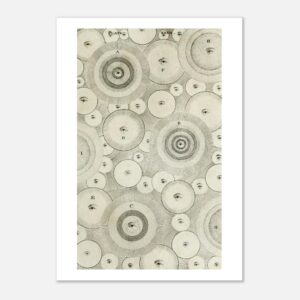
$34.00
A visionary glimpse into 18th-century cosmology, this hypnotic engraving by English astronomer Thomas Wright imagines the universe as a network of concentric star systems—each eye-like form possibly representing another galaxy.
First published in An Original Theory or New Hypothesis of the Universe (1750), this piece blends science, speculation, and symbolism in striking detail.
Printed as a museum-quality giclée on matte fine art paper (200gsm), using rich 12-color ink. Unframed. 8″x12″ with a 1″ white border.
-

$42.00 – $54.00Price range: $42.00 through $54.00
Is it a pinecone? Is it a dragon? Nope. It’s a pangolin. This beautifully weird creature is the four-toed manis, illustrated in 1789 by English zoologist George Shaw and artist Frederick P. Nodder. Featured in The Naturalist’s Miscellany, this vintage print brings rare charm and a little bit of armored elegance to your walls.
Printed as a museum-quality giclée on matte fine art paper (200gsm), using rich 12-color ink. Unframed. 11”x17″ or 16″x24″ with a 1″ white border.
-
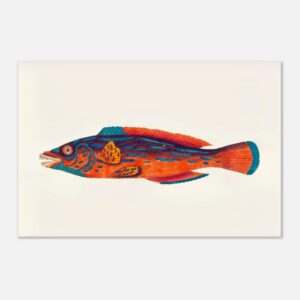
$42.00 – $54.00Price range: $42.00 through $54.00
Art by George Shaw – English zoologist, naturalist, and early platypus fanboy Vivid, weird, and scientifically elegant — this surreal sparus fish was originally published over 200 years ago by George Shaw, one of the first English naturalists to document Australia’s wildlife. Printed as a museum-quality giclée on matte fine art paper (200gsm), using rich 12-color ink. Unframed. 11″ x 17″ or 16″ × 24″ edge-to-edge (no border).
-

$40.00 – $52.00Price range: $40.00 through $52.00
Ivy Clouds and Swallows (c. 1900)
Is it a sky full of clouds pretending to be plants? Or plants pretending to be clouds? Either way, the birds don’t seem to mind. A delightfully odd, subtly surreal scene from Japanese painter Watanabe Shōtei, master of calm whimsy and delicate detail.
Printed as a museum-quality giclée on matte fine art paper (200gsm), using rich 12-color ink. Unframed. 11”x14” with a custom, irregular white border. (.5” on sides; .786” top and bottom) or 16” x 20” with .5” border on top and bottom, and 1.11” on either side.
-

$40.00
Plate XLVI (1764) by Martin Frobenius Ledermüller
A hand-colored microscope study of the upper surface of a pear leaf, drawn from Amusement microscopique — a richly illustrated 18th-century exploration of the natural world.
The intricate, geometric network of pores and cells is compared to human skin, nerves, and blood vessels — a visual argument for nature’s hidden complexity.
This plate reflects a deep curiosity about structure and design, even in the smallest living things.
Printed as a museum-quality giclée on matte fine art paper (200gsm), using rich 12-color ink. Unframed. 11”x14” with a custom, irregular white border.
-

$40.00
A microscopic look at a single fish scale — from a humble merluche — transformed into a hypnotic, radiating pattern.
Originally plain to the eye, it reveals an unexpected order and symmetry under magnification.
Ledermüller described it as visual proof of the sublime in the smallest things — beauty by design, not accident.
Printed as a museum-quality giclée on matte fine art paper (200gsm), using rich 12-color ink. Unframed. 11”x14″ with a 1″ white border.
-

$40.00
Plate XL (1764) by Martin Frobenius Ledermüller
A magnified comparison between a needle and a bee’s stinger, shown still encased in its sheath.
This hand-colored engraving from Amusement microscopique highlights the surprising flaws of manmade tools versus the intricate precision of natural ones.
Ledermüller’s goal was both scientific and philosophical — nature, he argues, wins.
Printed as a museum-quality giclée on matte fine art paper (200gsm), using rich 12-color ink. Unframed. 11”x14” with a custom, irregular white border.